
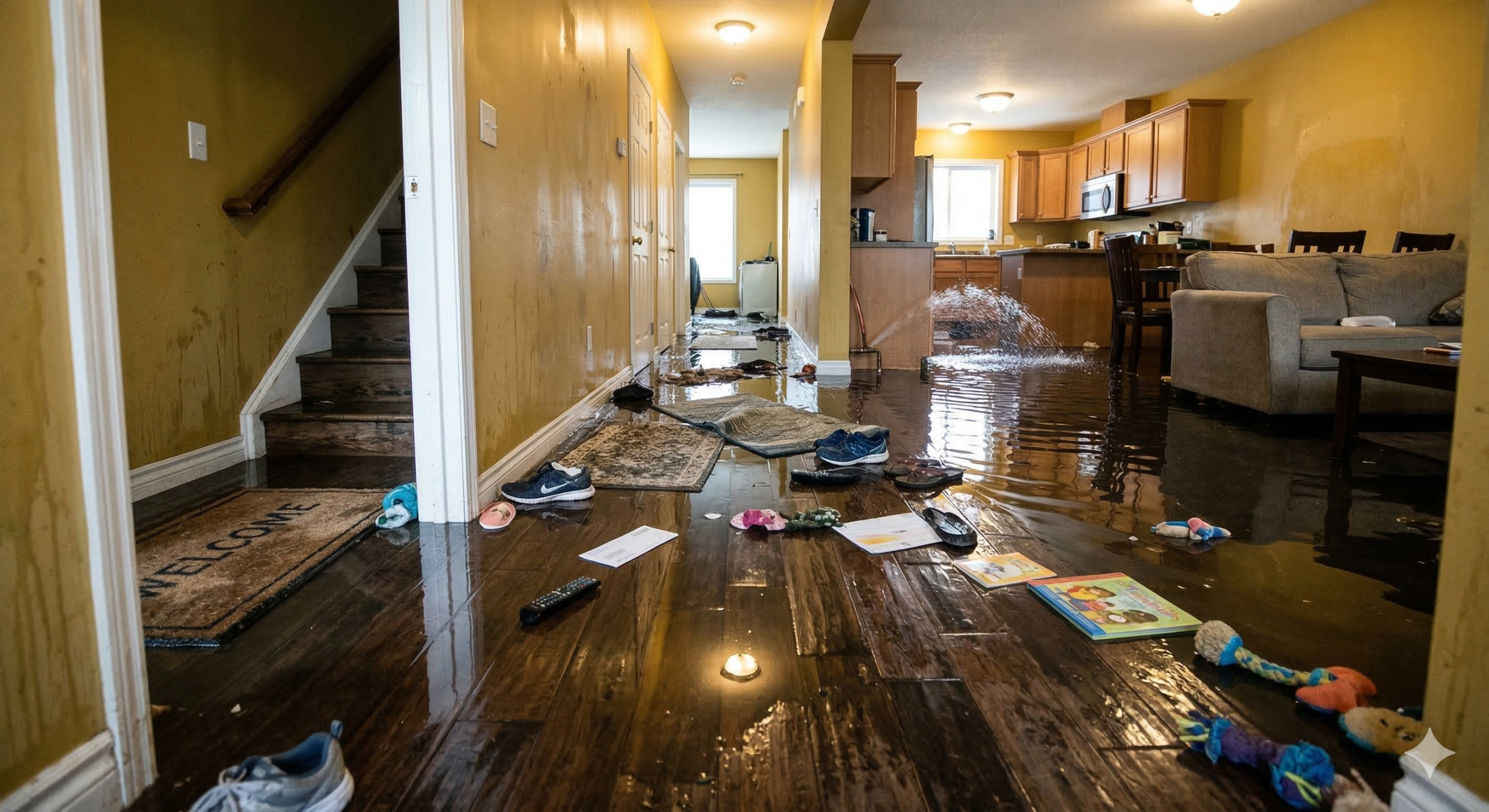
This is a story about the day my four-year-old son accidentally flooded our house.
But more than that, it’s a story about the moments when your own competence hits a ceiling—and who you know matters just as much as what you know.
The Sound of Rushing Water
It was an evening in the fall. My wife and younger son were out, and it was just me and my four-year-old. We were doing a simple chore: cleaning his goldfish bowl.
I had the fish safely tucked into a plastic bag filled with water. I handed my son the empty bowl and told him to go to the bathroom to fill it up with fresh water. A simple task, right?
A few seconds later, I heard a sound that didn’t fit the context of a small glass bowl. It was the roar of rushing water—the kind of volume you hear when you’re filling a large bathtub at full blast. Then came the screaming. My son ran from the bathroom, terrified, as a wall of water began to creep across the hardwood of the entrance hall and into the carpeted living room.
I ran to the bathroom and saw the nightmare: the supply hose that connected the sink to the water pipes inside the wall had snapped or come loose. It wasn’t a drip; it was a geyser.
The First Ceiling: Technical Knowledge
At that moment, I felt a very specific, grounded emotion: Scared.
This was the first home I had ever owned. I was a professional, a salesman, a father—but in that moment, I was a man standing in a lake with no idea how to stop it. No one had ever taught me about water shut-off switches. I didn’t know where the main valve was, and the water was rising by the second.
I did the only thing I could think of: I ran across the street.
My neighbor, Nick, was a retired state patrol officer. He’d helped me learn a few things here and there about home ownership. I knocked on the door and told him what happened. He didn’t panic. He just put on his shoes and walked back across the street with me.
“It’s probably in your garage somewhere,” he said calmly, referring to the shut-off switch.
In thirty seconds, Nick found the switch and killed the flow. The “emergency” was over, but the catastrophe had just begun.

The Second Ceiling: Institutional Authority
By 1:30 AM, a ServiceMaster crew was in my living room. They tore out the carpet and set up massive, industrial-strength dryer fans. The noise was a constant, low-frequency hum that made sleep impossible. My family and I spent the next two weeks living in a local hotel while our home was dried out, re-floored, and restored.
I was working for an American Family Insurance agent at the time, so I knew the drill. I filed a homeowners’ insurance claim. I assumed that because I was “on the team,” the process would be seamless.
I was wrong.
Claims adjusters are paid to protect the company’s bottom line. They started to quibble, questioning the details of the incident. They looked for ways to escape paying for the full restoration or the “Loss of Use” costs for our hotel stay. They use Information Asymmetry—knowledge of policy loopholes, and assume you will take them at their word.
That’s when my boss, Jeff Kearin, stepped in.
Jeff got on the phone with the claims adjuster and used his Institutional Authority. He told them, “This is one of my top salesmen. He makes tens of thousands of dollars for this company. You are going to pay this claim.”
Jeff didn’t argue the fine print; He argued the relationship. He understood something the adjusters didn’t: you don’t “cut off your nose to spite your face.” If you demoralize the people who bring in the revenue by denying them the very protection they sell to others, you undermine the entire engine of the business.
The quibbling stopped. They paid for every dollar of the restoration, the new flooring, and the hotel.
The Lesson: Relational Insurance
Looking back, I realize that I hit two “ceilings” that day.
The first was a Technical Ceiling. I didn’t know how to turn off the water. Nick was my “Knowledge Proxy”—he filled the gap in my competence.
The second was a Power Ceiling. I didn’t have the leverage to force a massive insurance corporation to honor its word. Jeff was my “Authority Proxy”—he filled the gap in my leverage.
We often hear that the key to success is self-reliance, but this flood taught me that a truly robust life is built on relational reliance. It’s about positioning yourself within a network where, when your agency fails, someone else’s authority is there to catch you.
You need to know where your water shut-off is. But more importantly, you need to know who is going to pick up the phone and fight for you when the water starts rising.
If you need someone like that in your corner for your insurance program, give me a call.